October 12, 2026
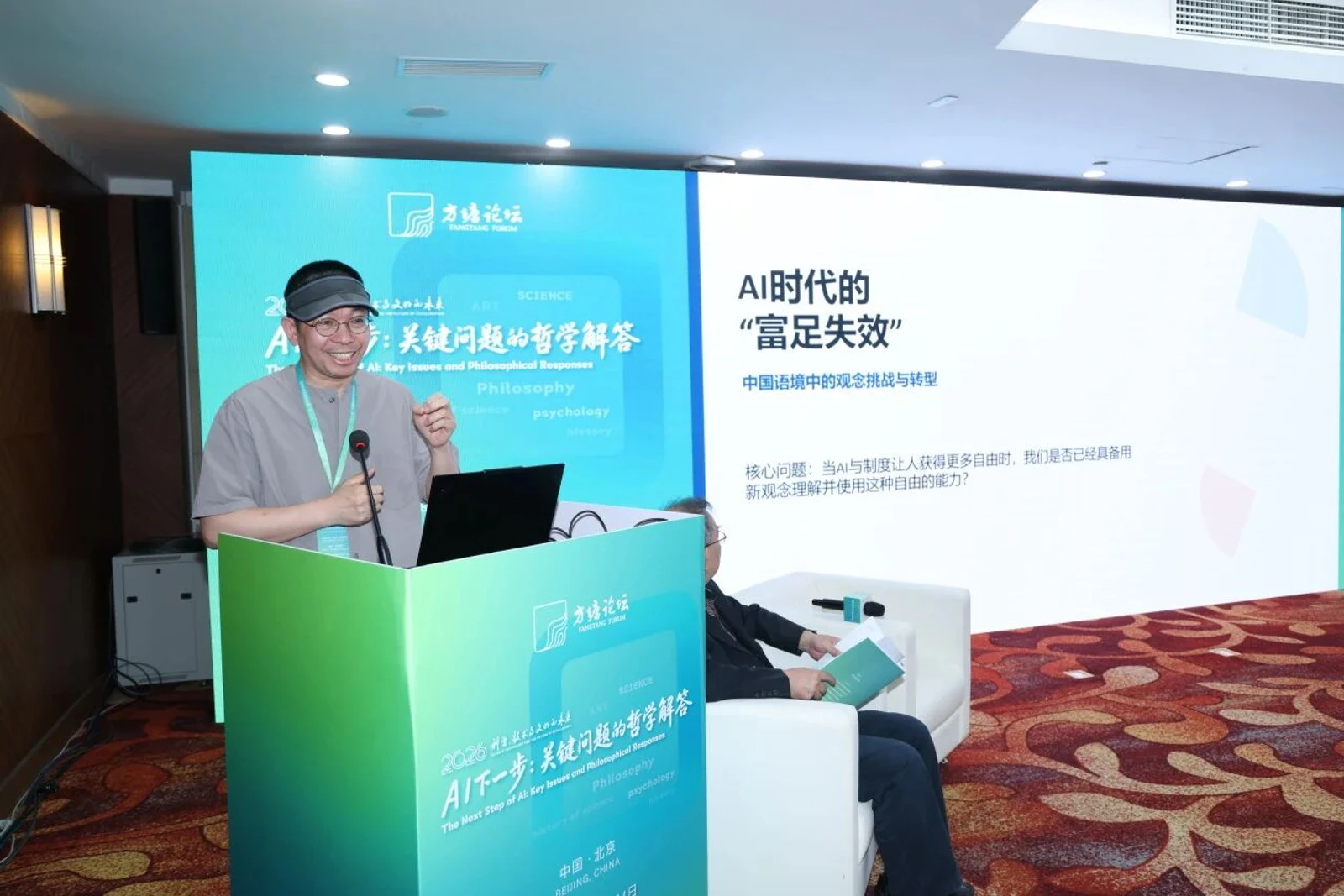
This is a talk by Ge Siyou, Professor of Philosophy at Wuhan University, at the panel on the post-work era of the 2026 Fangtang Forum. He sets aside his professional standpoint as a philosopher and speaks instead as the father of a middle-school student and an observer of contemporary education. His claim is that while material conditions have improved enormously, many people’s ideas remain shaped by an age of scarcity—a phenomenon he calls the “failure of affluence.” He argues that moving from subtractive thinking to additive thinking may be an important way of rediscovering one’s own worth. What follows are the main points of his remarks.
First of all, I would like to thank the organizers very much for the invitation. I once joked, “To keep up with Fangtang is to keep up with the times.”
My talk may be quite different from those of the previous speakers. I want to begin more from my own lived experience: as the father of a middle-school student, as a university professor, and as someone surrounded by friends whose children are preparing for postgraduate entrance examinations, applying to universities, or choosing their majors. These experiences have led me to think repeatedly about a particular problem. Strictly speaking, this problem was not caused by artificial intelligence. The arrival of AI has simply made it more pronounced.
I call this problem the “failure of affluence” in the AI era.
I. Why Are People Not Necessarily Living Better Even as Society Becomes More Affluent?
Younger people may not fully appreciate the scale of this change. People of my generation grew up in the 1980s and 1990s, when living conditions were simply incomparable to those of today. If we look at absolute material conditions—food, clothing, housing, and transportation—there is no question that we now live in a relatively affluent age.
And yet I often have the feeling that today’s children, and even young people who have grown up over the past ten or twenty years, may not enjoy a better overall quality of education and life than those of us who grew up poor and endured considerable hardship. That is where my thinking begins: why has this happened?
The arrival of AI has made the problem even more pronounced. Professor Jiang Xiaojuan just discussed the “post-work era” and argued that it may still be too early to speak of post-work. I do not think there is any substantive disagreement between us. Whether AI ultimately causes permanent unemployment or, as Professor Jiang suggested, mainly creates structural gaps between disappearing and emerging jobs, there will inevitably be some people who, for a certain period of time, have no work.
So of course we need to consider institutional arrangements such as Universal Basic Income (UBI). We need social distribution mechanisms that allow everyone to share in the technological dividend. Governments must first address these problems.
But I want to take the argument one step further. Even if all of this is done properly—even if a person can receive an income without having a job—does it follow that this person will necessarily live well?
My answer is: not necessarily.
If our ideas remain stuck in the past, then even with a universal basic income system, people may still fail to live good lives. For China, this problem is especially acute.
II. Ideas Formed in an Age of Scarcity Still Govern an Age of Affluence
I once studied a little economics. Near the end of The General Theory of Employment, Interest and Money, John Maynard Keynes makes a very famous observation. Roughly speaking, he says that the ideas of economists and political philosophers, whether right or wrong, are more powerful than is commonly understood; indeed, the world is ruled to a great extent by ideas.
That is precisely the issue I want to discuss today: how do ideas shape our lives? Why does the AI era require a transformation of ideas? And I especially want to place this question in the Chinese context.
I often say something to my friends: the fifty years since I was born may, in my personal view, be the best fifty years in China’s five-thousand-year history. Of course, that is only my own judgment. But what I want to emphasize is that, over the long course of history, Chinese society lived for centuries under conditions of severe scarcity. At least as I see it, many of our inherited views of life, values, and education were formed to adapt to an age of scarcity.
The problem today is that reality has changed dramatically, while our ideas have not necessarily changed with it.
Compared with the past, we no longer live under conditions of extreme scarcity. Yet most of us have not truly escaped the mentality formed in an age of extreme scarcity. As a result, a serious mismatch has emerged between our ideas and our reality.
This is the root of what I call the “failure of affluence.”
In some developed countries, material affluence emerged gradually over one or two centuries, and ideas had a relatively long period in which to adjust. China’s transformation has been far more compressed. If we narrow the period of genuinely large-scale material affluence even further, perhaps we are really talking about only the last twenty years or so. That makes the mismatch between ideas and reality even more severe.
III. AI Raises Not Only the Problem of Unemployment, but Also the Problem of Meaning
Let me share a very personal experience.
I have used AI extensively for more than a year. Gradually, I discovered that it could do an extraordinary range of things. There was even a period when I felt that more than 80 percent of the work I had done in the past had somehow lost its meaning.
Around 2022, the Chinese translation of Derek Parfit’s On What Matters, which I co-translated with Ruan Hang, was published. The whole work runs to roughly 1.6 or 1.7 million Chinese characters. In the past, many people said to me, “Professor Ge, you did something remarkable by translating such an extraordinarily difficult work.”
It took me many years.
But now I find myself thinking that, if I were to do it again today with the help of AI, I might be able to finish it in about six months. And I even suspect that the result might be better than what I produced before.
That was a tremendous shock to me.
I also have friends who are applying for national research grants or writing academic papers. They send me their materials because they know I am relatively familiar with AI and ask me to use it to help offer suggestions. Of course, I add my own judgment and then send them my proposed revisions. One friend, after reading the suggestions, said to me, “Professor Ge, I am beginning to feel that my life has lost its meaning.”
This is another problem created by AI.
Even if redistribution eventually solves the income problem, and even if unemployment no longer throws a person into a crisis of survival, we will still have to confront another question: when the work that once sustained one’s sense of self-worth suddenly ceases to matter, how is a person supposed to understand their life anew?
IV. Three Sayings: A Closed Circuit of Ideas from an Age of Scarcity
Why does this problem deserve particular attention in the Chinese context?
I have a basic judgment. What profoundly shapes us is not necessarily limited to the canonical texts of traditional Chinese philosophy. A large part of traditional culture reaches us through idioms, proverbs, and verses that we hear from childhood. As soon as a child begins to speak, that child gradually absorbs the ideas contained in such expressions.
Let me give three examples. Everyone here, especially those of my generation, will probably know them very well.
The first is:
“There is a path through the mountain of books, and diligence is the way; the sea of learning has no shore, and hardship is the boat.”
Many schools even hang this couplet on classroom walls.
The second is:
“In books there are houses of gold; in books there are beauties like jade.”
You may never have read the entire traditional Poem of Exhortation to Learning, but very few people have never heard these two lines. They encourage us to study hard, rise in the world, and get ahead.
The third is:
“Are kings, nobles, generals, and ministers born to their rank?”
Why have I chosen these three sayings? Because, in my view, together they form a remarkably complete closed circuit of ideas suited to a traditional society of scarcity. A view of life, a system of values, and a philosophy of education are all contained within it.
Let us begin with the first saying: “There is a path through the mountain of books, and diligence is the way; the sea of learning has no shore, and hardship is the boat.”
Why did we see nothing wrong with this sentence when we were young? I myself lived exactly that way. As a child, I got up at six in the morning and went to bed at ten at night, and I could even regard that as a happy life. Why? Because if I did not study, I had to go home and do farm work. Harvesting rice in temperatures of thirty-five or thirty-six degrees Celsius, or even hotter, was obviously more exhausting than sitting in a classroom.
So at that time, parents did not even need to lecture you repeatedly. You naturally felt that sitting in a classroom was more comfortable than working in the fields.
But if you give the same saying directly to children today, they may think, “Are you out of your mind?” The idea that “the sea of learning has no shore” is frightening enough, and then you are told that “hardship is the boat.” That means the entire process of learning is not only painful but endlessly painful.
Children today begin school at around six and continue until eighteen—twelve years. When they finish school each day, they are not going home to plant rice, harvest crops, or dig the soil. For many children, studying itself may be the hardest thing in their lives. Under such conditions, if we continue asking them to understand education through the mentality of an age of scarcity, why should we be surprised when psychological problems emerge?
Now consider the second saying: “In books there are houses of gold; in books there are beauties like jade.”
This saying contains a very clear set of values. If we look at traditional exhortations to learning as a whole, education ultimately points toward wealth, status, marriage, and other resources in life. In other words, education does more than tell people how to strive. It also presupposes what kind of life is worth striving for.
The problem is that most of these goals are strongly characterized by scarcity and relativity. Power, status, and social ranking are especially obvious: one person’s rise often entails another person’s relative decline. Even wealth, once it is understood primarily as a superior position in comparison with others, easily enters a competitive logic of distribution. From the perspective of game theory, these goals readily generate zero-sum games and, under excessive competition, may even deteriorate into negative-sum games. They are much less likely to produce a positive-sum situation from which everyone can benefit.
The third saying is: “Are kings, nobles, generals, and ministers born to their rank?”
We usually see this line as full of rebellious spirit, and of course it does have that meaning. But from another perspective, what exactly changes when you accept it? You challenge the idea that kings, nobles, generals, and ministers are “born” to their positions, but you do not necessarily challenge the hierarchical structure of kings, nobles, generals, and ministers itself.
In other words, you may object to the fact that “he can become a king or minister while I cannot,” yet still assume that success in life means becoming one of the “kings and ministers.”
That is why we also have another familiar saying:
“Only those who endure the bitterest hardships can rise above others.”
Where does the ideal of becoming “above others” come from? Its logic is continuous with the logic of kings, nobles, generals, and ministers.
So, in my view, our traditional outlook on life, our values, and our philosophy of education once fit an age of scarcity almost perfectly. When resources were extremely limited and much competition approached a zero-sum structure, the most realistic route to a better life was to struggle upward.
The problem is that the times have changed, yet we continue to reproduce the same set of ideas.
V. Why Might More Successful Parents Become More Anxious?
I have a view that may be rather bold and may not be entirely correct: many parents today still accept this system of ideas.
And the phenomenon may be especially pronounced among upper-middle-class families in large cities such as Beijing, Shanghai, Guangzhou, and Shenzhen.
Why?
Because many people of my generation benefited from the opportunities created by reform and opening up and by social mobility. Quite a number of us genuinely changed our lives through education. We moved beyond the environments in which we grew up and obtained better careers and better lives. When both husband and wife have risen through this path, they often become particularly anxious about their children.
Why? Because what they fear most is that their children may fall back into the conditions from which they themselves escaped.
So we see families investing astonishing amounts of resources in both international and domestic education. The more someone has succeeded through educational competition, the more likely they may be to impose the same path on the next generation.
How does the same mentality manifest itself among ordinary families?
One very typical phenomenon, I think, is the so-called “Hengshui High School model”—the highly intensive, examination-oriented educational model associated with Hengshui High School. Why has this model been accepted by so many people and replicated in so many places? In my view, it is precisely because ideas suited to an age of scarcity continue to exert a powerful influence.
I personally hold a very strong critical view of this model. As I see it, it is an inhumane mode of education. At Wuhan University, I have met several students with similar educational backgrounds. Some told me that one of the first things they had to do after entering university was to readjust their psychological state and behavioral habits. It took them a long time to gradually free themselves from certain patterns formed in the past.
Of course, these are only cases I have personally encountered. But they lead me to continue asking: why are we willing to choose this kind of education?
My answer remains the same: because our ideas have not truly left the age of scarcity behind.
VI. From “Rising Above Others” to “Living in One’s Own Way”
So what should we do?
I would not claim to have a complete answer. What follows may sound a little like “chicken soup for the soul,” and some people may even call it “toxic chicken soup.”
Many years ago, I read Those Things in the Ming Dynasty by DangNianMingYue. One can certainly debate many aspects of the series, but I have always loved its ending. No matter how many years pass, I still remember that the author ends with Xu Xiake.
Why end with Xu Xiake?
To me, the real significance of that ending is this: after an entire work filled with emperors, power, struggle, kings, nobles, generals, and ministers, we finally encounter someone who steps outside that closed circuit.
Of course, Xu Xiake had favorable family circumstances, and that cannot be ignored. But many children throughout history came from wealthy families, and not all of them lived as he did. Most still returned to the old circle of values and continued pursuing wealth, status, and power.
Xu Xiake was different.
What he did had little to do with the promise that “in books there are houses of gold” or that “in books there are beauties like jade.” He simply lived his life in the way he liked.
I think this may be precisely one of the ideas most lacking in Chinese society today: how can a person—and how can we allow our children—to spend a lifetime following their own interests?
Especially when money is no longer the greatest constraint, this question becomes increasingly important.
So I have rewritten the old saying, “There is a path through the mountain of books, and diligence is the way; the sea of learning has no shore, and hardship is the boat,” as follows:
“There is a path through the mountain of books, and interest is the way; the sea of learning has no shore, and joy is the boat.”
If AI truly increases productivity, and if institutional arrangements such as universal basic income eventually address people’s basic material needs, then for most people—provided their interests are not extraordinarily expensive—it may genuinely become possible to live in the way they like.
VII. From “Subtractive Thinking” to “Additive Thinking”
Finally, let me offer one more bowl of possibly toxic “chicken soup.”
Today we often praise someone as a “hexagon all-rounder”—someone who excels in every dimension. Behind this expression lies a very characteristic mode of thought.
I call it subtractive thinking.
What do I mean by subtractive thinking? I mean that, across all the criteria by which you are evaluated, if you fail in just one area, then you fail. You cannot get into universities such as Peking University, Tsinghua University, or Zhejiang University. In other words, you are not allowed to have weaknesses.
China’s National College Entrance Examination, or gaokao, of course has many strengths. It provides, among other things, an important mechanism of fairness. But it may also shape our thinking at a broader level: we become accustomed to evaluating a person by subtraction.
You must be good at everything.
In my work with students, I often encounter young people experiencing psychological difficulties. Everyone has weaknesses. I work in analytic philosophy, for example, and some students may simply not be suited to this style of research. The moment they discover that they are not suited to it, they immediately conclude that they themselves are inadequate.
I often tell them: you should not define yourselves through subtractive thinking. You should define yourselves through additive thinking.
What is additive thinking?
It means that if there is any one thing I can do reasonably well, then I already have a reason to accept myself.
I often joke: “There are not many hexagon all-rounders—but there are not many hexagon all-round failures either.”
Most people can do some things well and some things poorly. The question is whether we can stop treating one weakness as sufficient grounds for declaring an entire life a failure.
So I hope we can move from subtractive thinking to additive thinking. In learning and personal growth, we can begin from our own interests and continually discover things in different areas that can be added to our lives. In this way, perhaps everyone can find a form of value that belongs to their own life.
That is the central point I want to make today. The real challenge of the AI era is not only whether jobs will disappear. Nor is it only whether society can guarantee everyone an income through redistribution. The deeper question is this: when a society has gradually moved beyond extreme scarcity, while our ideas remain trapped in an age of scarcity, can we rethink education, success, and life itself?
If we cannot, then the more materially affluent we become, the more anxious we may grow.
But if we can, perhaps AI will bring not only a crisis of work, but also an opportunity to rethink what it means to live a good life.
Thank you.
- 2026 Fangtang Forum